

Collar
Order of St Olav
Norway
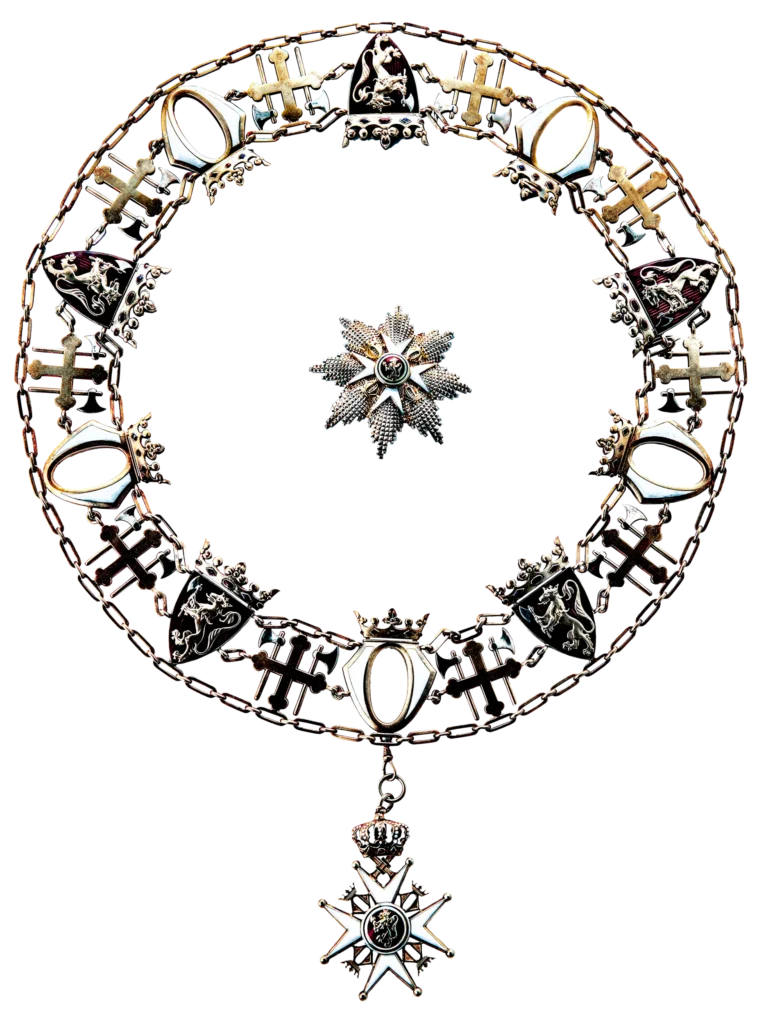
-1882-1906 Collar of the Order of the St Olav-
Country : Norway
Order name : St Olav
Type/subset: Collar
Jeweller : Tostrup
J period : 1882-1992
Owner :
Awarded to :
Height (mm):
Width (mm):
Weight(gr) :
Tracking # : N377x
Date : 1882-1906 model


Sold at Probus Auktioner 19.11.2018 for 6000 Euros.
-1884.06.17 Collar of the Order of the St Olav-
Country : Norway
Order name : St Olav
Type/subset: Collar
Jeweller : Tostrup
J period : 1882-1992
Owner : Collection Cicoia
Awarded to : Prins Wilhelm of Sweden
Height (mm): 34
Width (mm): 940
Weight(gr) : 206
Tracking # : N076
Date : 1884.06.17 awarded


This collar was awarded to Prins Wilhelm of Sweden and Norway (1861-1951).
- Grand Cross of St. Olav, with Collar, 17 June 1884
-1882 Collar Order of the St Olav-
Country : Norway
Order name : St Olav
Type/subset: Collar
Jeweller : Tostrup
J period : 1882-1992
Owner :
Awarded to :
hHeight (mm):
Width (mm):
Weight(gr) :
Tracking # : N993x
Date : 1882 model


-1906 Collar Order of the St Olav-
Country : Norway
Order name : St Olav
Type/subset: Collar
Jeweller : Tostrup
J period : 1882-1992
Owner :
Awarded to :
hHeight (mm):
Width (mm):
Weight(gr) :
Tracking # : Nbcd N211x Collar
Date : 1906

Collar did turn up at auctions a few times in the 1980s in London. One of them was from the former King Konstantin of Greece.
Jeweller Tostrup:
The earliest Tostrup stamps were always positive and appear in conjunction with the usual town mark, guardein and lodighets stamps, as well as year and month marks. The oldest known stamp is IT, which appears from 1832 to about 1860. From 1834 onwards, IHT appears and was in use until at least 1840. Sometime in the 1840s (first recorded in 1847), TOSTRUP was used exclusively, and it is reasonable to assume that this continued until the mid-1860s, as it is recorded in 1863. An italicised Tostrup is known from 1835.
During Oluf Tostrup's time, a new method of stamping was introduced, whereby all stamps were stamped in negative. TOSTRUP is most often used in connection with KRISTIANIA, the year and the parish stamp, but also J. TOSTRUP or just J T. After Oluf Tostrup's death, the same stamps were used for some time. In the 1920s, however, a company mark began to be stamped instead of or next to the letter stamp, the well-known Tostrup jug. This mark has been used more and more in recent years, while the company started using positive stamps again around 1924. Next to the jug, J. TOSTRUP also appears, either written together or crossed out as J T. The dimensions of the stamps have varied considerably in recent times, depending on the size of the object. Occasionally, especially in works from 1914, the engraved signature J P = Jakob Prytz appears.
Tostrup basically produced the St Olav orders from 1882 until they went bankrupt in the 1990s.
Around 1880, Tostrup also began experimenting, and during the short period when Oluf Tostrup was the sole owner of the company, intensive work on the enamel became the main problem facing the company. A favourable result would be expected to generate increased opportunities in the international market. The Fili spruce had now reigned supreme for twenty years. It was reasonable to anticipate a decline in its popularity. If the company could successfully master the enamel technique, which had begun around 1880, it would ensure the continued success of its international market position.
However, at that time, the successful experiments were viewed from a national perspective. The company's ability to take over the production of St. Olav's Order, which until then had been made in Stockholm, was a significant achievement and a national milestone. At the Industry and Art Exhibition in Christiania in 1883, a detailed review of Tostrup's work was published, stating: 'Although it is undoubtedly an honour that the country's only order is produced here at home, this has not been the case until now. However, should there be any uncertainty regarding the delivery of such work here, it is imperative that these concerns are now addressed and resolved.
The orders carried out by Mr Tostrup surpassed the foreign works of the same kind with which they could be compared in terms of the lustre and texture of the enamel and the purity and depth of the colours. As early as 1849, Tostrup had received orders for individual items, which continued on and off until the decorations were partly ordered from Tostrup and partly from Stockholm. However, it was not until the 1880s that it was decided that the Order of St. Olav should only be produced in Norway, and the work has since been entrusted to Tostrup.
In his capacity as royal court jeweller and jeweller to the Order of St. Olav, Torolf Prytz designed the insignia for the Lord of the Norwegian Law in 1904, and in 1906 he redesigned the Order of St. Olav for Haakon VII and designed the new chain of the order. In this regard, it should be noted that the company boasts an extensive range of orders, decorations, medals and sports badges (currently over 1,000), including the Student Society's Pig Order, the Artists' Association's Purple Order, the Journalists' Squid, the Sports Badge and the Army Sharpshooter's Badge.
Following 1900, Prytz had limited opportunities to design for himself. The management of his ever-growing business and his many public duties took up more and more of his time and energy.

-1906.11.13 Collar Order of the St Olav-
Country : Norway
Order name : St Olav
Type/subset: Collar
Jeweller : Tostrup
J period : 1882-1992
Owner :
Awarded to :
hHeight (mm):
Width (mm):
Weight(gr) :
Tracking # : Nbcd N211x Collar
Date : 1906.11.13 awarded


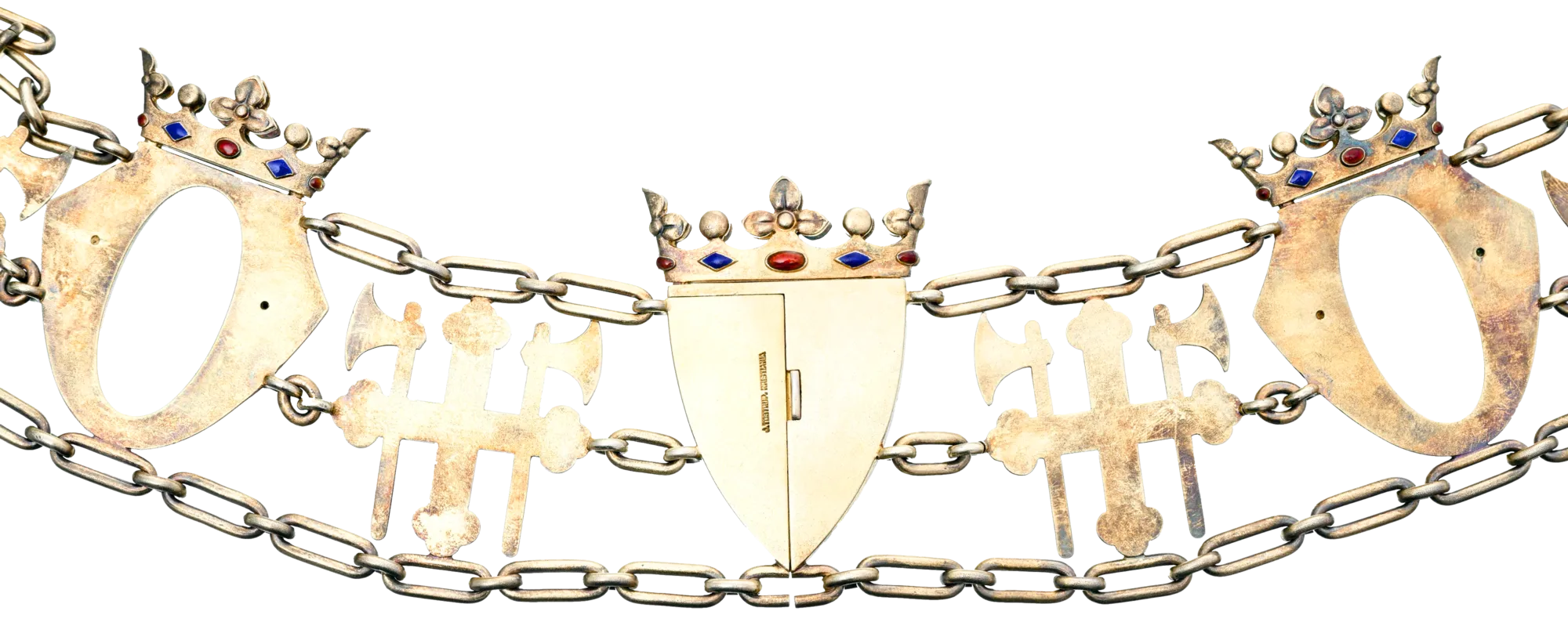


This model of the St Olav collars arrived on the market in 1906 after the independence from Sweden. When this collar was made is not certain. It was initially awarded to Prince Friedrich Christian Carl August of Schleswig-Holstein on 1906.11.13. Which means it was one of the first of this type to be awarded this early. There is a tradition with these St Olav collars that the name of the person awarded it is engraved into the reverse side of this collar. Below you will see a photo of the engraving with the persons name. This is redone later one when another person is awarded the same collar.
In 1922.09.19 this same collar was awarded to Umberto II who was then the Prince of Italy. Since then the collar is assumed to have stayed in the family of earlier King Umberto II. It is assumed that his name is also engraved into the revere.
THE ORDERS AND DECORATIONS OF HM KING HUMBERT II OF Italy:
Diplomatic and dynastic itinerary
The last sovereign of the Kingdom of Italy, Humbert II of Savoy (1904–1983), prince of Piedmont then king in May 1946, embodies the final chapter of the Italian monarchy resulting from the Risorgimento. Heir to a centuries-old dynasty, he was very early called upon to represent Italy on the international scene, in a Europe where the exchange of orders constituted a true diplomatic language.
From his youth, the prince received the highest distinctions from European courts and the great monarchies of Central and Eastern Europe. These orders consecrate his rank among the heirs called to reign, seal the personal links between sovereigns and highlight the central place occupied by the House of Savoy in Europe.
Beyond Europe, the distinctions received reflect the protocol importance given to the Prince of Piedmont in international relations between the wars and illustrate the eminent rank of Humbert II on the world stage.
After the 1946 referendum and the exile of the royal family, these decorations took on a new dimension: having become witnesses of lost sovereignty, they preserved the memory of a monarchical world profoundly disrupted by the 20th century.
Maison Piguet is honored by the trust placed in it and has the privilege of unveiling this unique and exceptional set of orders and decorations received by His Majesty King Humbert II of Italy, which have remained in his descendants to this day.
Lots 1794 to 1837 collected in this catalog can be consulted on our site by entering the keywords "Savoie, Savoy or Savoia" in the search bar.
-1925.07.09 Collar Order of the St Olav-
Country : Norway
Order name : St Olav
Type/subset: Collar
Jeweller : Tostrup
J period : 1882-1992
Owner : Historisk Museum Oslo
Awarded to : Fridtjof Nansen
Height (mm):
Width (mm):
Weight (gr):
Tracking # : N991x
Date : 1925.07.09 awarded collar

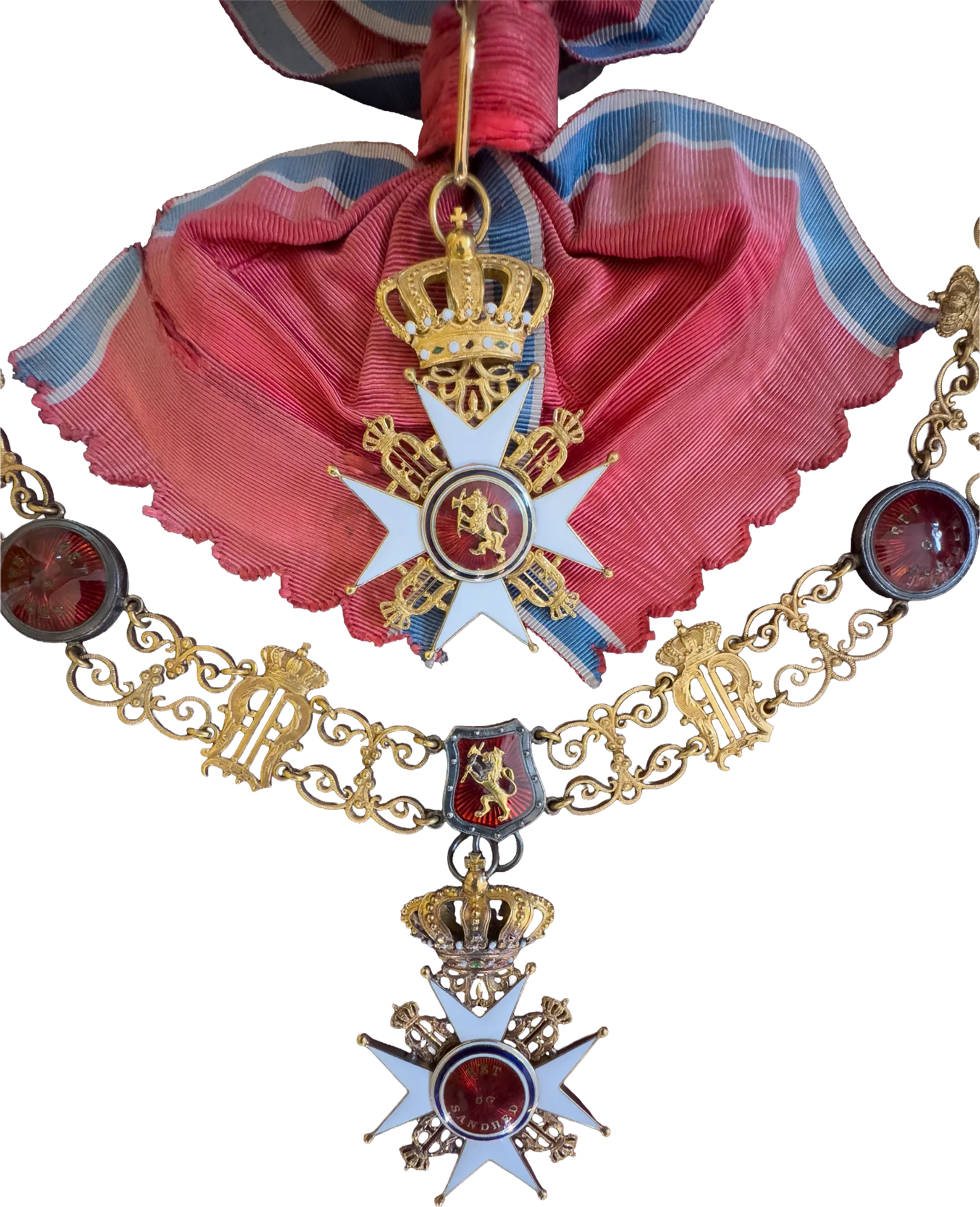

The Norwegian explorer Fridtjof Nansen was awarded the Grand Cross of St Olav 1896.09.09. Many years later he was also awarded the St Olav Collar in 1925.07.09. In 1905 the design of the orders were changed in Norway. It has not been possible to find any photos from the award ceremony in order to see which model of the Collar he was awarded. Maybe the thinking was that he should have received the first type of collar?? Actually from 1882 to 1906 you mostly were awarded the Collar with the Grand Cross. So maybe the collar was forgotten to be awarded for one of the true heros of Norway? It will be interesting to see if it there were any written documentation on this issue at that time.
-1941.10.08 Collar Order of the St Olav-
Country : Norway
Order name : St Olav
Type/subset: Collar
Jeweller : Tostrup
J period : 1882-1992
Owner :
Awarded to : Otto Ruge - General
Height (mm):
Width (mm):
Weight(gr) :
Tracking # :
Date : 1941.10.08 awarded

-1953.01.29 Collar Order of the St Olav-
Country : Norway
Order name : St Olav
Type/subset: Collar
Jeweller : Tostrup
J period : 1882-1992
Owner :
Awarded to : Vincent Auriol, President France
Height (mm):
Width (mm):
Weight(gr) :
Tracking # : N998x
Date : 1953.01.29 awarded


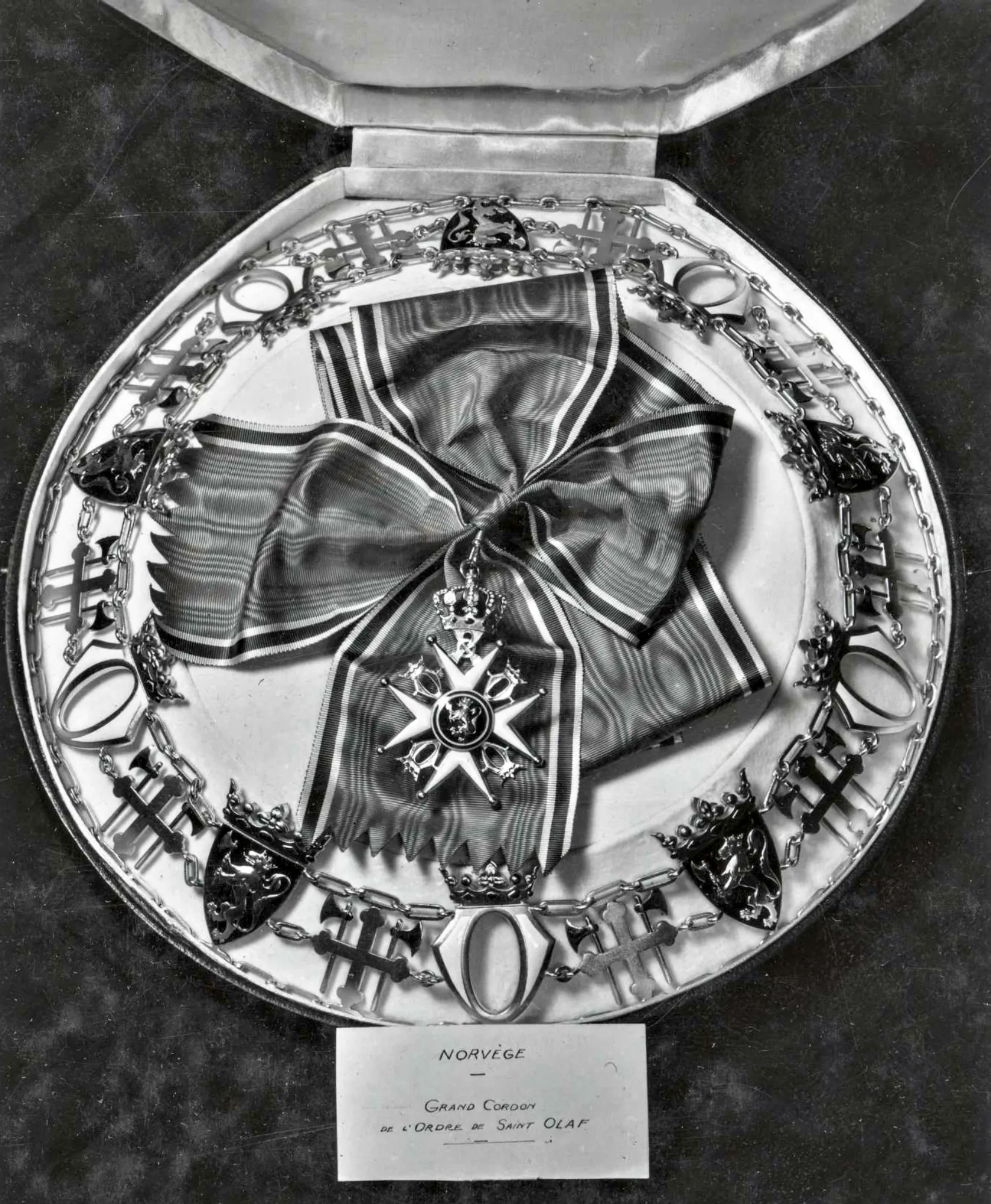
-1965.05.13 Collar Order of the St Olav-
Country : Norway
Order name : St Olav
Type/subset: Collar
Jeweller : Tostrup
J period : 1882-1992
Owner : Chancery Royal Castle Oslo
Awarded to : President Tito of Yugoslavia
hHeight (mm):
Width (mm):
Weight(gr) :
Tracking # : N996x
Date : 1965.05.13 awarded


-1964 Collar Order of the St Olav-
Country : Norway
Order name : St Olav
Type/subset: Collar
Jeweller : Tostrup
J period : 1882-1992
Owner :
Awarded to :
hHeight (mm):
Width (mm):
Weight(gr) :
Tracking # : Nbcd N211x Collar
Date : 1964 Hallmarked


